I am a researcher in social psychology and evolutionary anthropology interested in the psychological mechanisms underlying group cohesion and social learning, as well as the cultural evolution of rituals and religion. My work integrates experimental, quantitative and computational approaches, with earlier training in cognitive neuroscience using EEG and pupillometry.
I completed my PhD at the University of Oxford under the supervision of Prof Harvey Whitehouse, at the Centre for the Study of Social Cohesion (CSSC). I am now based at the Peace Research Institute Oslo (PRIO) and part of the ERC project Com2Civ (led by Julia Palik) which aims to understand how rituals influence the social reintegration of ex-combatants in Colombia and the Philippines.
Other interests also include polarization, extremism, conspiratorial beliefs, norm psychology, the evolution of music and morality as cooperative devices.
Working Papers
Magic and ritual as affiliative strategies in response to ostracism threat
Submitted and in review
The transmission of rituals and magical practices is a fundamental feature of human culture, yet the psychological mechanisms underpinning their persistence remain contested. The Bifocal Stance Theory (BST; Jagiello et al., 2022a; Whitehouse, 2021) posits that individuals adopt either a ritual stance, which prioritizes social affiliation and norm adherence, or an instrumental stance, which emphasizes efficiency in achieving goal-directed outcomes. We hypothesize that actions can be viewed by social learners through the lens of either stance depending on a variety of contextual cues. To test this hypothesis, we employed an online adaptation of the pen-and-cups paradigm (Leighton et al., 2010), in which participants repeatedly observed and reproduced modelled actions. They were randomly assigned to one of four conditions (clear, expert, magic or ritual), systematically manipulating verbal frames, causal opacity, goal demotion, and the resolvability of opacity (i.e. whether the causal structure was in principle knowable). Crucially, we investigated whether social exclusion also influences imitative fidelity. Our findings provide the first experimental evidence that individuals experiencing ostracism exhibit higher copying fidelity for actions that are causally opaque in irresovable ways compared to instrumental and resolvable ones. These results support the view that when actions are interpreted and transmitted as “rituals” and “magic”, they serve social and affiliative functions, reinforcing group cohesion and cooperation rather than merely supporting the transmission of technically useful information. Moreover, our findings challenge and extend existing accounts of cultural learning which argue that cultural transmission is primarily a matter of instrumentally directed learning. We argue that integrating both affiliative and instrumental perspectives is essential for a comprehensive understanding of the psychological foundations of cultural learning.
Model similarity cues cultural selection of ritualized actions
Submitted and in review
Ritualistic imitation appears to be affiliative and may function as a re-inclusion behaviour in response to ostracism threat (Watson-Jones, Whitehouse, & Legare, 2016). The Bifocal Stance Theory (BST; Jagiello, Heyes, & Whitehouse, 2022; Whitehouse, 2021) predicts that model similarity activates affiliative motivations and increases adoption of ritualized traits during cultural transmission, while prestigious models promote adoption of traits interpreted as causally efficacious. In a preregistered experiment, adult participants completed a two-block food choice task in which items were subjected to either causally opaque or causally transparent action sequences (Kapitány & Nielsen, 2017). Participants were paired with a social partner whose perceived similarity and prestige were experimentally manipulated. Choices were made privately in the first block and publicly in the second. Ritualized options elicited a robust choice preference in social contexts. When choices were made publicly, participants were more likely to select the ritualistically treated option when it had been chosen by a similar partner than when it had been chosen by either a prestigious or control partner, whereas prestigious partners did not reliably increase selection for instrumentally treated options compared to the other two partner conditions. We discuss implications for future work on similarity and prestige in cultural evolution.
Publications
Tradition and invention: The bifocal stance theory of cultural evolution
Behavioral and Brain Sciences (2022)
Cultural evolution depends on both innovation (the creation of new cultural variants by accident or design) and high-fidelity transmission (which preserves our accumulated knowledge and allows the storage of normative conventions). What is required is an overarching theory encompassing both dimensions, specifying the psychological motivations and mechanisms involved. The bifocal stance theory (BST) of cultural evolution proposes that the co-existence of innovative change and stable tradition results from our ability to adopt different motivational stances flexibly during social learning and transmission. We argue that the ways in which instrumental and ritual stances are adopted in cultural transmission influence the nature and degree of copying fidelity and thus also patterns of cultural spread and stability at a population level over time. BST creates a unifying framework for interpreting the findings of otherwise seemingly disparate areas of enquiry, including social learning, cumulative culture, overimitation, and ritual performance. We discuss the implications of BST for competing by-product accounts which assume that faithful copying is merely a side-effect of instrumental learning and action parsing. We also set out a novel “cultural action framework” bringing to light aspects of social learning that have been relatively neglected by behavioural ecologists and evolutionary psychologists and establishing a roadmap for future research on this topic. The BST framework sheds new light on the cognitive underpinnings of cumulative cultural change, selection, and spread within an encompassing evolutionary framework.
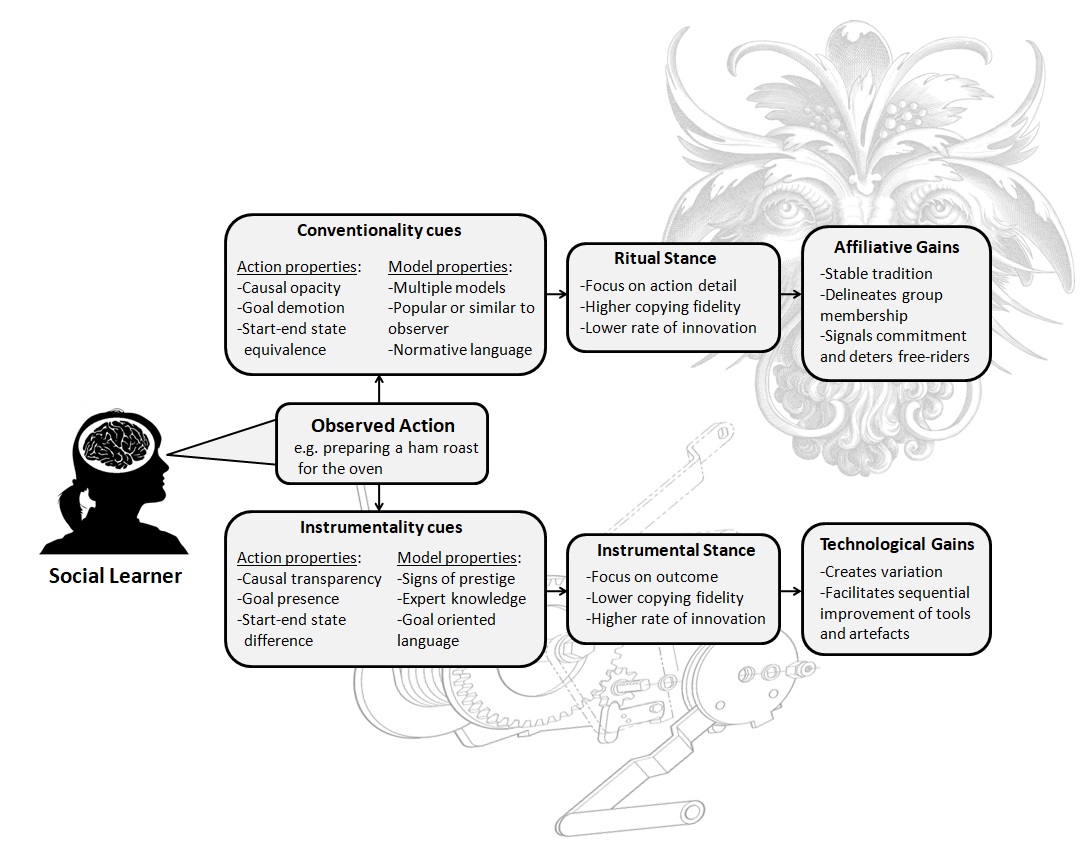
The Bifocal Stance Theory of Cultural Evolution (BST)
This diagram illustrates how social learners can interpret the same observed action through two different learning stances, depending on the cues available in the environment. When actions are accompanied by conventionality cues, learners are biased toward a ritual stance, prioritising faithful imitation over outcomes. This stance signals group commitment and supports social cohesion. In contrast, instrumentality cues encourage a stance in which learners prioritise effectiveness, experiment more and introduce innovation.
BST explains how the same actions can function either as socially binding traditions or as flexible technologies, depending on how learners interpret them.
Bifocal Stance Theory: An effort to broaden, extend, and clarify
Behavioral and Brain Sciences (2022)
The Bifocal Stance Theory (BST) of cultural evolution has prompted a wide ranging discussion with broadly three aims: to apply the theory to novel contexts; to extend the conceptual framework; to offer critical feedback on various aspects of the theory. We first discuss BST’s relevance to the diverse range of topics which emerged from the commentaries, followed by a consideration of how our framework can be supplemented by and compared to other theories. Lastly, the criticisms that were raised by a subset of commentaries allow us to clarify parts of our theory.
Rapid Brain Responses to Familiar vs. Unfamiliar Music – an EEG and Pupillometry study
Scientific Reports (2019)
Human listeners exhibit marked sensitivity to familiar music, perhaps most readily revealed by popular “name that tune” games, in which listeners often succeed in recognizing a familiar song based on extremely brief presentation. In this work, we used electroencephalography (EEG) and pupillometry to reveal the temporal signatures of the brain processes that allow differentiation between a familiar, well liked, and unfamiliar piece of music. In contrast to previous work, which has quantified gradual changes in pupil diameter (the so-called “pupil dilation response”), here we focus on the occurrence of pupil dilation events. This approach is substantially more sensitive in the temporal domain and allowed us to tap early activity with the putative salience network. Participants (N = 10) passively listened to snippets (750 ms) of a familiar, personally relevant and, an acoustically matched, unfamiliar song, presented in random order. A group of control participants (N = 12), who were unfamiliar with all of the songs, was also tested. We reveal a rapid differentiation between snippets from familiar and unfamiliar songs: Pupil responses showed greater dilation rate to familiar music from 100–300 ms post-stimulus onset, consistent with a faster activation of the autonomic salience network. Brain responses measured with EEG showed a later differentiation between familiar and unfamiliar music from 350 ms post onset. Remarkably, the cluster pattern identified in the EEG response is very similar to that commonly found in the classic old/new memory retrieval paradigms, suggesting that the recognition of brief, randomly presented, music snippets, draws on similar processes.
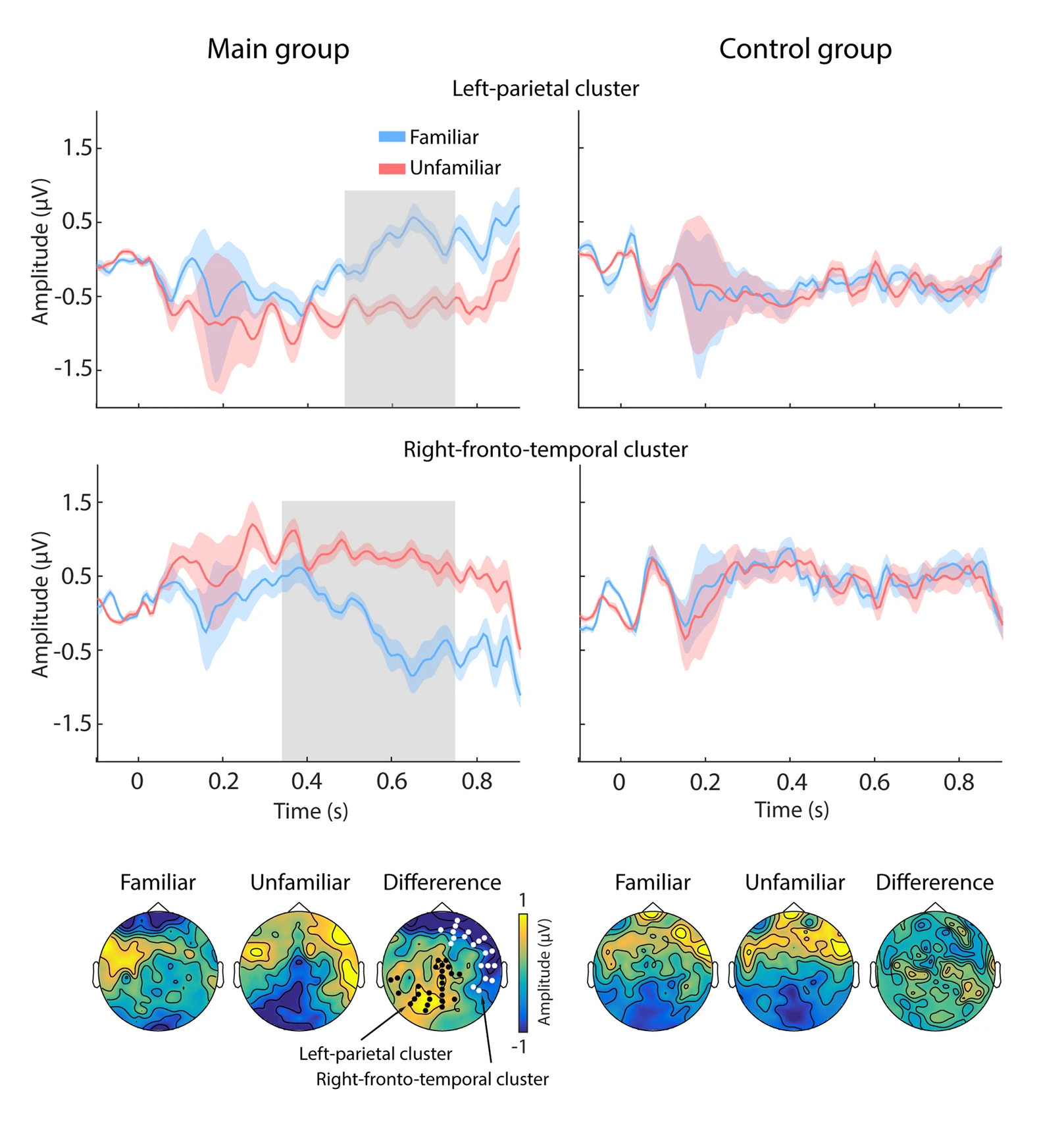
Brain responses to musical familiarity.
Listeners who were familiar with the music showed robust differences in neural activity compared with unfamiliar excerpts, whereas control listeners showed no such effects. These differences emerged late in time and were distributed across parietal and fronto-temporal brain regions.
The findings indicate that familiarity effects in music reflect higher-level cognitive processing, illustrating how learned cultural knowledge can shape brain responses.
Bad News Has Wings: Dread Risk Mediates Social Amplification in Risk Communication
Risk Analysis (2018)
Social diffusion of information amplifies risk through processes of birth, death, and distortion of message content. Dread risk—involving uncontrollable, fatal, involuntary, and catastrophic outcomes (e.g., terrorist attacks and nuclear accidents)—may be particularly susceptible to amplification because of the psychological biases inherent in dread risk avoidance. To test this, initially balanced information about high or low dread topics was given to a set of individuals who then communicated this information through diffusion chains, each person passing a message to the next. A subset of these chains were also reexposed to the original information. We measured prior knowledge, perceived risk before and after transmission, and, at each link, number of positive and negative statements. Results showed that the more a message was transmitted the more negative statements it contained. This was highest for the high dread topic. Increased perceived risk and production of negative messages was closely related to the amount of negative information that was received, with domain knowledge mitigating this effect. Reexposure to the initial information was ineffectual in reducing bias, demonstrating the enhanced danger of socially transmitted information.
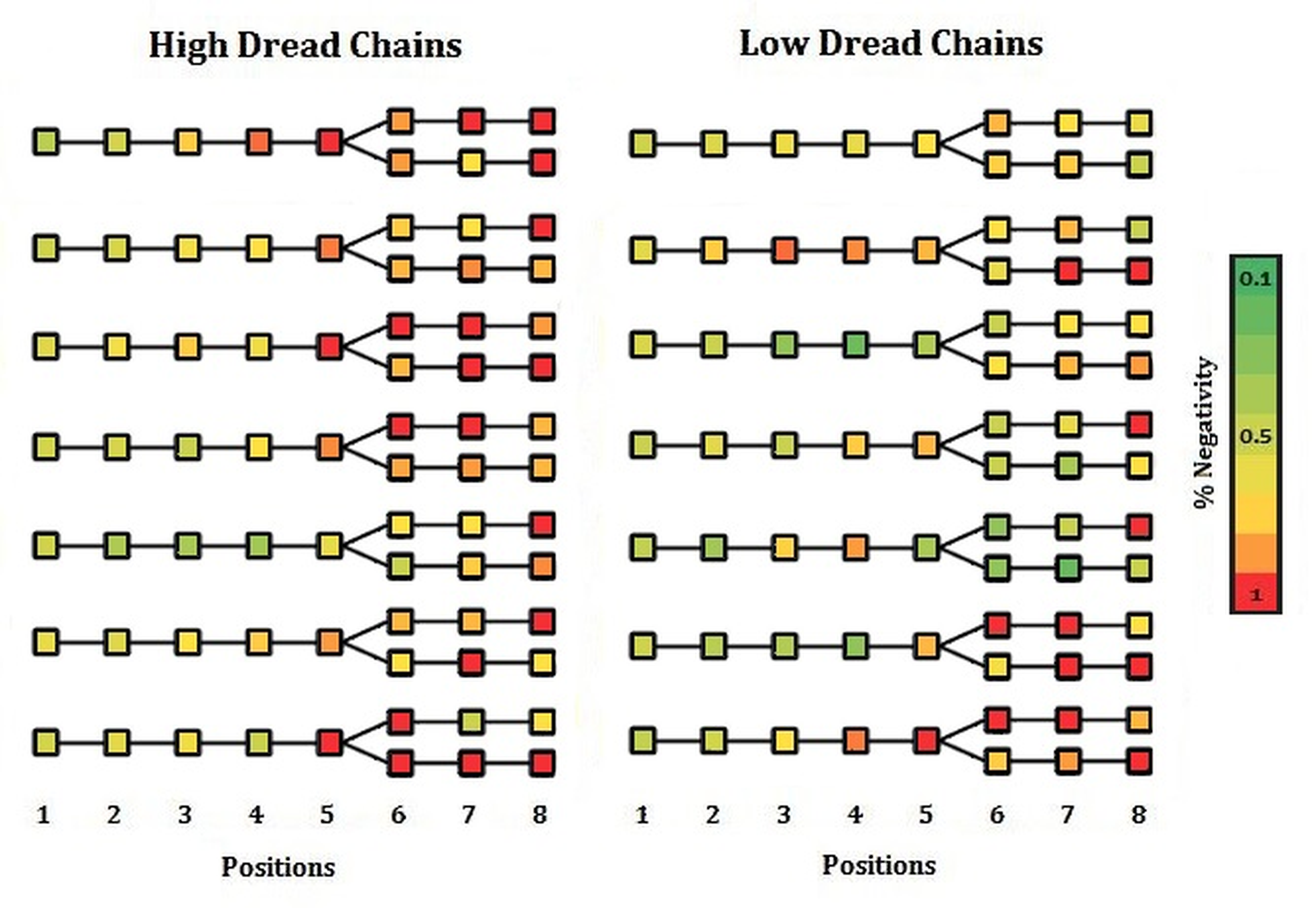
Social amplification of risk across diffusion chains
This figure shows how information changes as it is passed from person to person. Each square represents one individual in a transmission chain and colour indicates the proportion of negative content in the message they transmitted (green = low negativity, red = high negativity). Messages about high-dread risks (left panel; e.g. nuclear accidents) accumulate negative content more rapidly than messages about low-dread risks (right panel; e.g. food additives).
Upper branches show chains that were re-exposed to the original information, while lower branches were not. Despite re-exposure, negativity continues to increase, demonstrating how socially transmitted information can amplify perceived risk in irreparable ways.
Media
-
On the neuroscience of music:
-
On risk communication and crowd hysteria:
Teaching
-
2019–2023 — Tutor in Cognition and Culture, St Catherine’s College, University of Oxford
This tutorial series examined the evolution of human cognition and its relationship to the production and transmission of cultural content, including knowledge, morality, music, language, rituals, and belief systems. Topics were embedded in a framework addressing how interactions between mind and culture have shaped human societies over time. Core questions included how cognition gives rise to culture, how culture feeds back into cognitive development, and whether cultural practices are best understood as adaptive solutions or as by-products of cognitive mechanisms evolved for other purposes.
-
2019–2021 — Tutor in Behaviour and its Evolution, Human Sciences (BA), University of Oxford
These tutorials explored whether and how evolutionary theory can inform the scientific study of human behaviour. Students critically compared major evolutionary approaches, including human behavioural ecology, cultural evolution, and evolutionary psychology. Particular attention was paid to distinguishing ultimate and proximate explanations and evaluating the evidential strengths and limitations of competing evolutionary frameworks through case studies.
-
2019–2021 — Tutor in Human Development and Evolution, Human Sciences (BA), University of Oxford
These tutorials focused on evolutionary approaches to human ontogeny, addressing how developmental processes interact with ecological, cultural, and life-history factors across childhood and adolescence. Core themes included developmental plasticity, life history theory, the evolution of prolonged childhood, stress and environmental calibration, and the role of cultural learning in shaping developmental trajectories.